Tucked into an inlet of Lake Lucerne and surrounded by mountains, Lucerne has established itself as an “easy” alpine base. In fact, there are so many natural landmarks at its fingertips that the city is nicknamed “Switzerland in miniature.”
If sunrise swims and sunset summits sound appealing, Lucerne might be your perfect alpine base. Here’s how to plan a weekend getaway and experience its prettiest scenery for yourself.
Getting There
International visitors typically arrive at Zurich Airport (ZRH), which is approximately 70km northeast of Lucerne. The train between ZRH and Lucerne railway station (Bahnhof Luzern) takes an hour, and tickets cost around $30. Alternatively, splurge on a taxi transfer.
In Switzerland, the rail routes are notoriously scenic, and for travelers already within Europe, consider completing the entire journey by train. Bahnhof Luzern has international connections, and since the train from Paris to Lucerne takes less than five hours, there’s a strong argument for the efficiency of European rail travel.
Where to Stay
A view of Chapel Bridge, one of the most iconic sights in Altstadt, on a sunny morning.
📍Lucerne📌 Chapel Bridge
Lucerne follows the shape of the lake, creating natural pockets of distinct neighborhoods. The city is situated at the outflow of Lake Lucerne, where the water flows into the Reuss River.
Put simply, choosing a neighborhood has a big impact on your experience. Perhaps you’re envisioning medieval spires and pastel buildings (that’s Alstadt) or maybe you’re veering towards a remote mountain detox (Bürgenstock). Here’s where to stay.
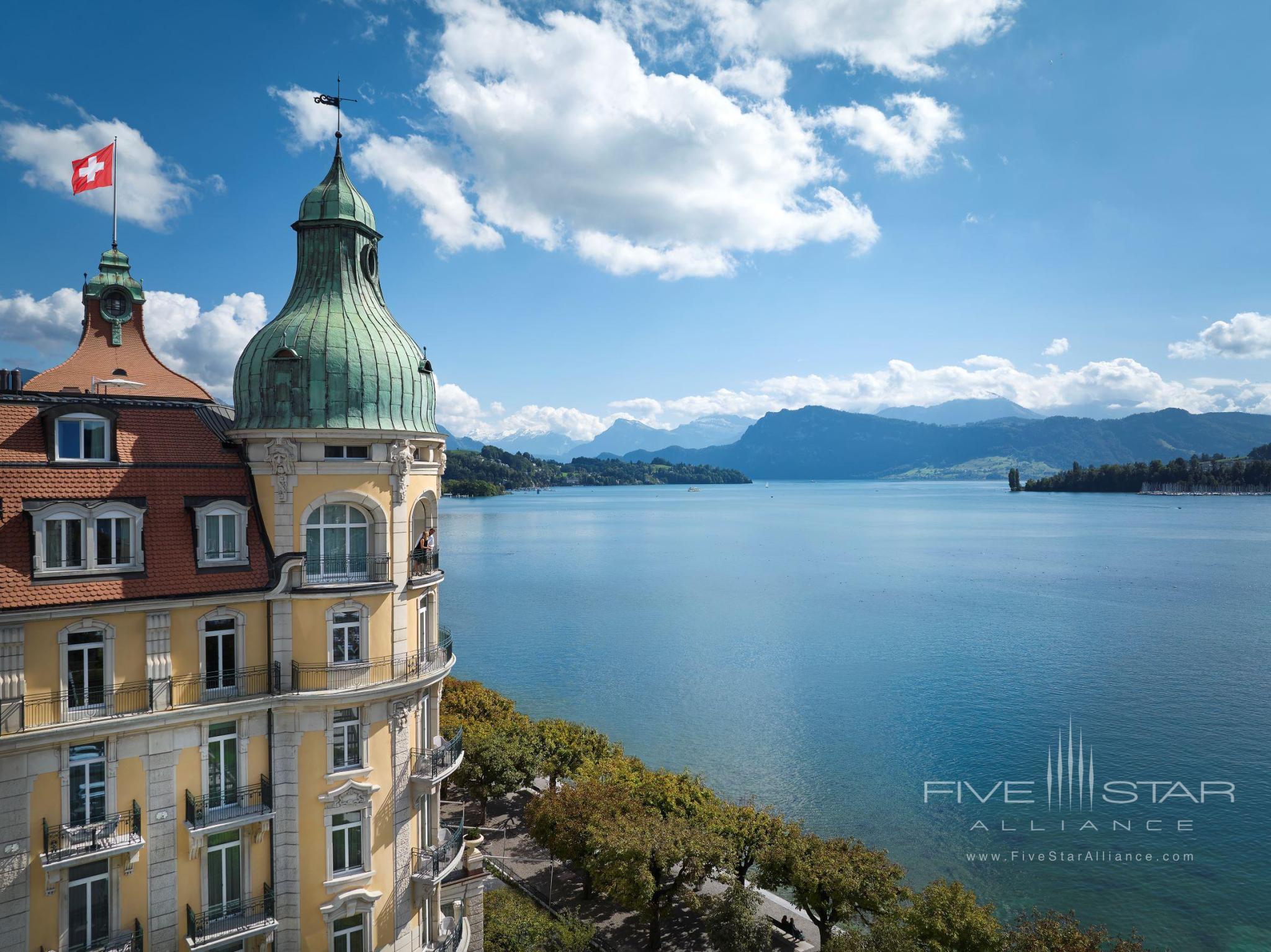
- •Alstadt is Lucerne’s Old Town, and for first-time visitors, the most beautiful place to stay. Within this historic district, Mandarin Oriental Palace Luzern is a prime choice, perched scenically on the northern bank of the Reuss River. Art Deco Hotel Montana is set slightly higher up the slopes, with sweeping views of Lake Lucerne.
- •Tribschen, the neighborhood around Lucerne’s train station, is excellent for value-conscious accommodation. Stay at Radisson Blu Hotel Lucerne, with lakeview rooms and a convenient location.
- •Bürgenstock is 40 minutes from central Lucerne via a scenic ferry and funicular. Set on the opposite side of Lake Lucerne, this isolated mountain is an optimal choice for visitors craving rejuvenation over convenient sightseeing. Stay at Bürgenstock Hotel & Alpine Spa, embracing the serenity of waterfront views and isolation in nature.
Mountains Near Lucerne
A red carriage completing the steep journey up Mount Pilatus.
📍Lucerne📌 Mount Pilatus
Situated at the foothills of countless slopes, it’s actually feasible to go “mountain-hopping” in Lucerne. Scrambling up each peak might be a strenuous task, but with cogwheel railways and cable cars, these alpine summits are almost instantly accessible.
Mount Pilatus and Mount Rigi are the most popular of Lucerne’s peaks. Mount Pilatus stands at 2132m and is easily reached via the world's steepest cogwheel railway, while Mount Rigi is 1797m and accessible via Europe’s oldest mountain railway.
As another title-holder, Mount Stoos is connected to Lucerne by the world’s steepest funicular railway. It’s not the only recordbreaker, either: Mount Stanserhorn has 360-degree panoramic views from the world’s only CabriO railway.
Ironically, while all these mountains are unusually accessible, the actual transportation is an adrenaline-pump in itself. There’s something ridiculously novel about trundling up a mountain slope on a record-breaking railway.
A further two peaks, Mount Titlis and Brienzer Rothorn, are accessible by cable cars. But, for those keen to keep their feet on the ground, Sonnenberg is a hiker-friendly option. This low-lying “baby” peak has an affinity for vineyards and is easily tackled on foot.
The Prettiest Lakes
A ferry crossing Lake Lucerne on a bright morning with alpine mountains in the background.
📍Lucerne📌 Lake Lucerne
For anyone dreaming of beautiful lakes, Lucerne doesn’t disappoint. Set on the shores of Lake Lucerne, it feels like the city has lakefront views at every twist and turn.
Start by booking a tour of Lake Lucerne, which has traditional paddle steamers, panoramic yachts, and motorized boat tours. Then, branch out. For an inner-city swim, Lake Rotsee is known as Lake Lucerne’s “little brother” and is only a 30-minute walk from Altstadt.
Lacing up the hiking boots, it’s possible to plan trips to nearby alpine lakes, like Änggelauenseeli. Further afield, Lake Brienz has beautiful waterfalls and views of Interlaken. Take a 2.5-hour train or hire a car for the hour-long drive.
Beneath the Alps
Crossing the Reuss River via Chapel Bridge, which is lined with red flowers.
📍Lucerne📌 Chapel Bridge
Everyone needs downtime. Returning from the lofty heights of the surrounding Swiss Alps, Lucerne has plenty of low-altitude attractions.
Visit Chapel Bridge, the Glacier Garden of Lucerne, and Museum Luzern. Check for upcoming markets, too; between April and December, artisanal craftspeople showcase their products in the Old Town.
Venturing outside of Alstadt, the Lucerne Visitor Card grants discounted public transport to different neighborhoods, including bohemian Bruch.
Equally, after all that fresh air, you’ll have worked up an appetite. Lucerne is as much a culinary destination as it is a base for outdoor adventure. The region is revered for its wine, chocolate, and cheese — book tours and tasting experiences.
The Takeaway
For a spontaneous weekend in the Alps, Lucerne has the logistical ease to appeal to last-minute bookers, reluctant hikers, and scenery-obsessed. Travelers have the beauty of lakes and mountains at their fingertips. Nobody can ask for more than that.


 Five Star Alliance


